

Mental toughness is less about being “hard” and more about staying steady when emotions spike, plans change, or progress feels slow. A strong mindset combines self-awareness, disciplined follow-through, and flexible thinking—so challenges become manageable instead of overwhelming. The steps below focus on practical exercises, repeatable routines, and simple tracking methods that turn resilience into a daily skill.
If you want a deeper look at resilience skills and how they work in real life, the American Psychological Association’s overview of resilience is a helpful foundation.
Mental toughness doesn’t show up only during big moments. It’s built (and revealed) in ordinary situations: when you’re tired, distracted, uncertain, or frustrated. Here’s what it typically looks like in practice:
One simple way to tell you’re improving: you spend less time negotiating with yourself and more time taking the next useful action.
Mental toughness can feel abstract until you break it into trainable skills. These three areas—focus, self-talk, and stress tolerance—create a sturdy base for calm confidence under pressure.
Task-switching drains energy and increases the feeling of overwhelm. For the next 25–45 minutes, pick a single target outcome (one task, one finish line). Keep it measurable: “draft the email,” “outline the proposal,” “finish 10 pages,” or “clean the kitchen counters.”
Pressure tends to trigger identity-based statements: “I’m bad at this,” “I always mess up,” “I’m not disciplined.” Replace them with process statements that point to training and next actions: “I haven’t trained this skill enough yet,” “I need a simpler plan,” or “I can do one small rep right now.” This keeps the mind in problem-solving mode.
If you want additional science-backed methods for calming the nervous system, the CDC’s guide to coping with stress offers practical options.
| Day | Focus | Action | Reflection Prompt |
|---|---|---|---|
| 1 | Awareness | Write the top 3 situations that reliably trigger stress or procrastination | What pattern shows up most often? |
| 2 | Focus | Do one 25-minute session on a delayed task (phone in another room) | What helped attention stay on track? |
| 3 | Self-talk | Rewrite 5 common negative thoughts into neutral, actionable statements | Which rewrite felt most believable? |
| 4 | Discomfort tolerance | Choose one safe discomfort (hard workout, cold rinse, difficult email) and complete it | What did the mind predict vs. what actually happened? |
| 5 | Consistency | Keep one promise to yourself that is small but meaningful | How did keeping the promise affect confidence? |
| 6 | Recovery | Do a 10-minute calming routine (breathing, walk, stretch) after a stressor | How long did it take to return to baseline? |
| 7 | Purpose | Write a short “why” for your next 30 days and pick one priority habit | What will make this worth it even when it’s hard? |
To support recovery and attention control, many people also benefit from mindfulness basics. The NIH’s NCCIH overview of meditation and mindfulness breaks down simple, practical starting points.
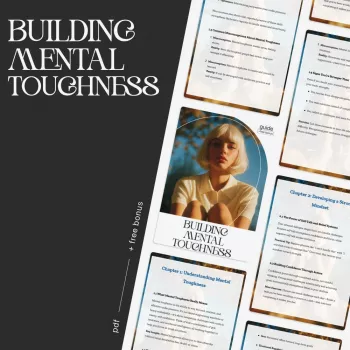
If you prefer a ready-to-use structure, the Building Mental Toughness Guide | Digital Download for Personal Growth | Mindset Strength Workbook | Self-Improvement eBook | How to Build Mental Toughness is designed to make daily practice straightforward with repeatable prompts and progress tracking.
Noticeable improvements often show up within a few weeks of consistent practice, especially with focus training and small daily promises. Deeper resilience typically builds over months as you repeat the skills, review setbacks, and keep raising the difficulty gradually.
No—mental toughness includes emotional awareness and regulation. It means acknowledging what you feel while choosing effective actions, rather than suppressing emotions or letting them drive impulsive decisions.
Use minimum-viable habits, reduce friction in your environment, and rely on if/then plans to get started. Keeping one small promise protects momentum and reinforces the identity of someone who follows through.











Leave a comment