
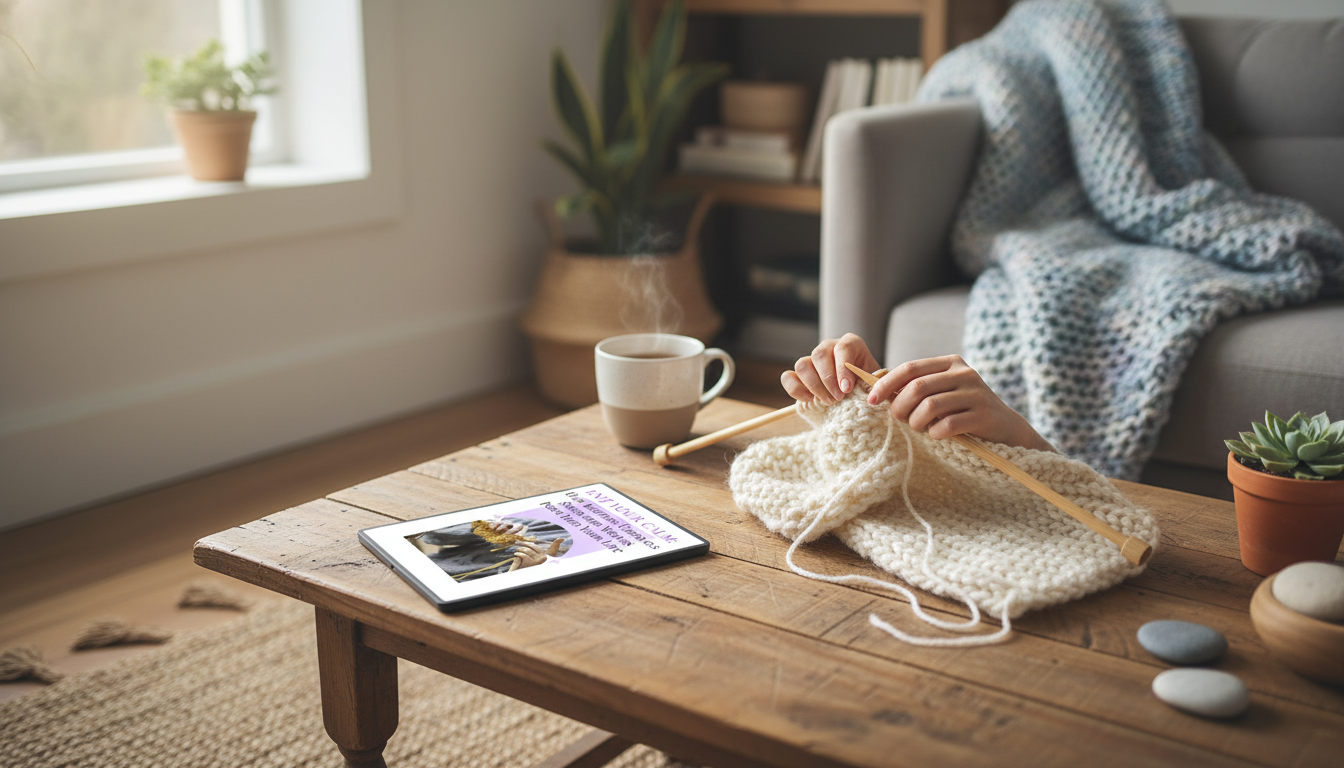
Knitting can turn restless energy into steady rhythm—one stitch at a time. The gentle repetition, tactile focus, and visible progress make it a practical way to decompress after work, steady anxious thoughts, and create small pockets of calm throughout the day. This guide breaks down why knitting helps, how to set it up as a mindfulness habit, and how to choose the right patterns and materials for stress relief.
Stress often pulls attention in too many directions at once: worries loop, muscles brace, and the mind searches for certainty. Knitting counters that “too much” feeling with something simple and physical.
That’s also why knitting can feel restorative even when life is complicated: it offers a small corner of order—loop, loop, loop—until your nervous system remembers what “steady” feels like.
A soothing knit session tends to narrow attention to simple cues—counting, noticing tension, watching stitch shapes form. That narrowing can reduce mental clutter and make stress feel less urgent. Predictable hand movements can also lower the sense of threat and uncertainty that fuels anxious scanning.
Many knitters notice that breathing naturally settles into a more even rhythm while stitching. Pairing knitting with intentional breath (without forcing it) can amplify the downshift. And if time is tight, short, frequent sessions—5 to 15 minutes—can be surprisingly effective when practiced consistently.
| Signal | What it may mean | Simple way to encourage it |
|---|---|---|
| Shoulders drop | Body tension releasing | Exhale slowly every 6–8 stitches |
| Jaw unclenches | Stress response easing | Relax tongue to the roof of the mouth |
| Breath becomes steadier | Nervous system settling | Inhale for 4 stitches, exhale for 6 |
| Less urge to multitask | Improved attentional stability | Knit without screens for 10 minutes |
For a deeper look at how stress shows up physically, the American Psychological Association’s overview of stress effects on the body is a helpful reference. For mindfulness research and safety considerations, see the National Center for Complementary and Integrative Health.
Mindfulness doesn’t require perfect calm. It’s the act of noticing what’s here—on purpose—and returning when the mind drifts. Knitting makes that return easy because the stitches are always waiting for you.
Small consistency beats intensity. A calm habit grows faster when it’s easy to begin.
On rough days, decision fatigue can make even a hobby feel like “too much.” A short routine can help you start without negotiating with yourself.
Stopping while you still feel good is part of the reset. It teaches your body that knitting equals relief, not strain.
Not every project soothes every mood. The most calming option is often the one that matches your current capacity.
| Current state | Best project style | Why it helps |
|---|---|---|
| Overwhelmed | Small, repetitive item | Low decisions; fast progress |
| Anxious and restless | Simple pattern with counting | Gentle structure for attention |
| Mentally drained | Mindless comfort project | Minimal cognitive load |
| Need a confidence boost | Quick-finish accessory | Clear completion cue |
| Bored or under-stimulated | Moderate texture or stripes | Engaging without overload |
If you enjoy a deeper unwind, consider pairing knitting with a brief mindfulness practice; Harvard Health Publishing’s overview offers practical context on why mindfulness can support stress reduction.
It can be. Mindfulness is paying attention on purpose, and knitting becomes a mindfulness practice when you choose a steady focus cue (breath, counting, or sensation) and gently return to it when your mind wanders.
For quick regulation, 5–15 minutes can be enough; for a deeper unwind, many people prefer 20–40 minutes. Stop before hand fatigue, and prioritize consistency over long sessions.
Lower the complexity, add stitch markers or a lifeline, and switch to forgiving textures where tension changes are less visible. Keeping a simple “comfort project” for high-stress days can help knitting stay supportive instead of stressful.






Leave a comment