
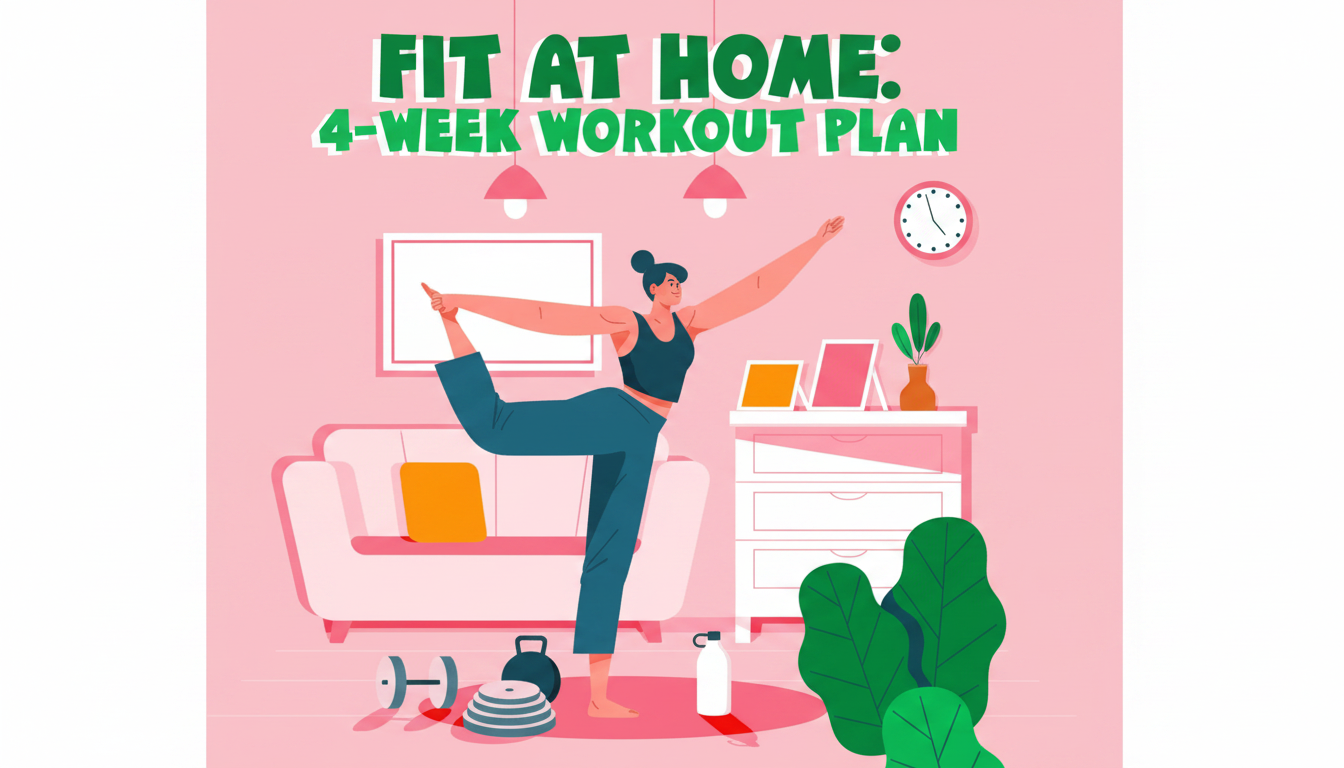
A structured four-week routine can make home training feel simple: a clear schedule, repeatable movement patterns, and short daily mobility work. This guide lays out how to run a minimal-equipment plan week by week, what to do each day, how to progress safely, and how to adapt sessions for small spaces, busy schedules, and different fitness levels.
This plan uses a steady rhythm—enough repetition to build skill and strength, with enough variety to keep it engaging. Most people do best with 4–6 training days per week and 1–3 lower-intensity recovery or mobility days.
“Minimal equipment” can mean a band and a mat—or it can mean a backpack and a chair. Choose what you have and keep your setup consistent.
| Goal | If You Have Equipment | If You Have None |
|---|---|---|
| Squat loading | Dumbbell goblet squat | Backpack front squat |
| Hinge strength | Dumbbell RDL | Hip hinge + slow tempo good-mornings |
| Pulling strength | Band rows | Towel isometric rows against a doorframe (safe setup) |
| Core stability | Dead bug with band | Dead bug bodyweight |
| Conditioning | Jump rope | Marching high knees / step jacks |
The “best” plan is the one you can repeat consistently. Start by picking a time commitment, then match intensity to recovery.
For general health targets that pair well with this plan, see the Physical Activity Guidelines for Americans and the CDC guidance on physical activity.
Repeat this weekly structure for four weeks, using the progression rules later in the guide. If you need fewer days, keep Days 1, 2, 4, and 6 as your anchors.
| Day | Main Focus | Suggested Duration | Daily Stretch Emphasis |
|---|---|---|---|
| 1 | Lower body strength | 30–40 min | Hips + calves |
| 2 | Upper body strength | 30–40 min | Chest + upper back |
| 3 | Recovery | 20–45 min | Spine + hips |
| 4 | Full-body circuit | 25–35 min | Quads + shoulders |
| 5 | Posterior chain + core | 30–40 min | Hamstrings + glutes |
| 6 | Conditioning | 20–30 min | Ankles + hip flexors |
| 7 | Rest | 10–20 min | Full-body mobility |
Each workout day is built from the same menu, so you can swap variations without changing the structure. Aim to keep 1–3 reps “in the tank” on strength moves unless you’re advanced and recover well.
Progression is what turns “a workout” into “a plan.” Track sets/reps (or work/rest) and a 1–10 effort rating so you can progress without guessing.
For strength training frequency and structure benchmarks, the ACSM resistance training recommendations provide helpful context.
Four days per week is a strong baseline for noticeable strength and fitness gains, especially when progression is consistent. If recovery is good, adding a fifth or sixth day can increase conditioning and weekly training volume, while daily mobility can still be done on rest days.
Use a loaded backpack, water jugs, slower tempo reps, pauses, and isometric holds to make bodyweight work challenging. Progress by adding reps, increasing time under tension, and reducing rest between sets while keeping form controlled.
Yes—repeat it with slightly higher reps/sets, harder variations, or longer interval blocks. If fatigue builds up, insert an easier week (lower volume and more mobility work) before pushing progression again.











Leave a comment