
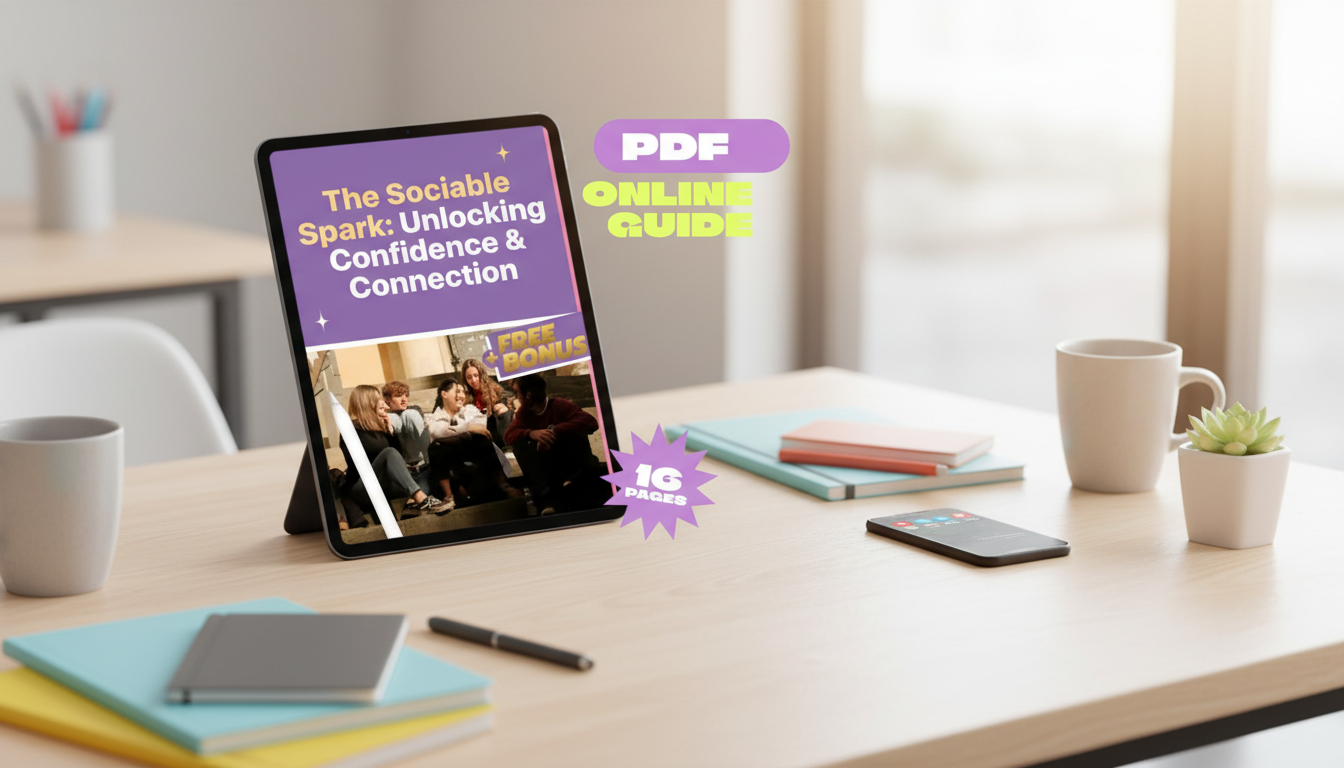
Building confidence in social situations is a skill set that can be learned and practiced—without changing personality or forcing constant small talk. This digital guide is designed to help turn everyday interactions into easier, more natural moments of connection through practical steps, simple exercises, and repeatable routines.
Instead of waiting to “feel ready,” the approach focuses on tiny reps you can do in real life: a greeting that doesn’t drag on, a follow-up question that keeps things moving, and simple recovery tools for those inevitable awkward beats. Over time, these small actions stack into steadier presence and more comfortable connection.
Social discomfort often comes with stress responses—racing thoughts, tense muscles, a “blank mind” moment. Understanding that stress is a normal body signal (not a personal failure) can help reduce self-judgment and keep you in the interaction long enough to build real skill. For a helpful overview of how stress shows up physically, see the American Psychological Association’s resource on stress effects on the body.
If fear or avoidance feels intense and significantly disrupts school, work, or relationships, it may help to pair self-guided practice with professional support. The National Institute of Mental Health overview of Social Anxiety Disorder offers clear criteria and next-step options.
These ideas work because they take pressure off performance. Rather than trying to “win” a conversation, you’re practicing presence: making eye contact, tracking what someone said, and responding in a way that shows you’re with them. Over time, that responsiveness becomes your default—especially in familiar settings like the same hallway, the same weekly meeting, or the same coffee shop.
| Situation | What to say or do | Skill it trains |
|---|---|---|
| Passing a neighbor or coworker | Make eye contact, smile, and say a simple greeting | Initiation and ease |
| Checkout or café counter | Ask one friendly question (e.g., “How’s your day going?”) | Starting small talk |
| Work or class setting | Give a specific compliment (effort, idea, choice) | Warmth and positivity |
| Group conversation | Ask a follow-up to someone else’s point | Engagement without interrupting |
| After an awkward moment | Name it lightly and pivot (“Anyway—”) | Recovery and resilience |
A useful way to evaluate any guide is to ask: “Will I actually do this on a regular Tuesday?” If the tools rely on long scripts, dramatic personality shifts, or hours of journaling, the plan may collapse under real life. The strongest resources make it easy to get reps—because repetition is what creates reliability.
One practical mindset shift: treat social confidence like physical conditioning. Nobody expects a single workout to change everything—but a short routine done consistently changes what feels normal. Social connection also has real health benefits, and stronger relationships are associated with better well-being over time; see Harvard Health Publishing on the benefits of strong relationships.
Progress often shows up within days when practice is frequent and low-stakes; bigger comfort in groups can take weeks of consistent reps. Focus on repetition and recovery rather than trying to feel fearless.
Awkwardness is a normal part of learning and doesn’t mean you’re doing it “wrong.” Use quick repair tools: acknowledge lightly, ask a simple follow-up, or exit politely and try again later.
Yes—confidence and sociability are learnable skills, not personality types. The goal can be fewer, higher-quality interactions with less stress, not constant outgoing energy.










Leave a comment